Resources Hub

Article
Why intent data fails without buyer context
You see intent data everywhere in B2B growth plans. Vendors promise earlier visibility, better timing, and sharper targeting. The pitch sounds simple. Find in-market accounts, build custom audiences, and push outreach faster.
That logic breaks when you treat intent as a shortcut. Intent works best as signal input, not shortcut. If you ignore buyer context, third-party data points to activity without telling you who matters, why interest is rising, or how your team should respond.
That gap matters more now. According to Forrester, 73% of purchases involve three or more departments, with an average of 13 internal stakeholders. Intent at the account level tells you something is happening. It does not tell you which people shape the decision.
For revenue teams, that is the core problem. You do not need more signals alone. You need buyer context that turns third-party data into coordinated buying team activation.
Product sheet
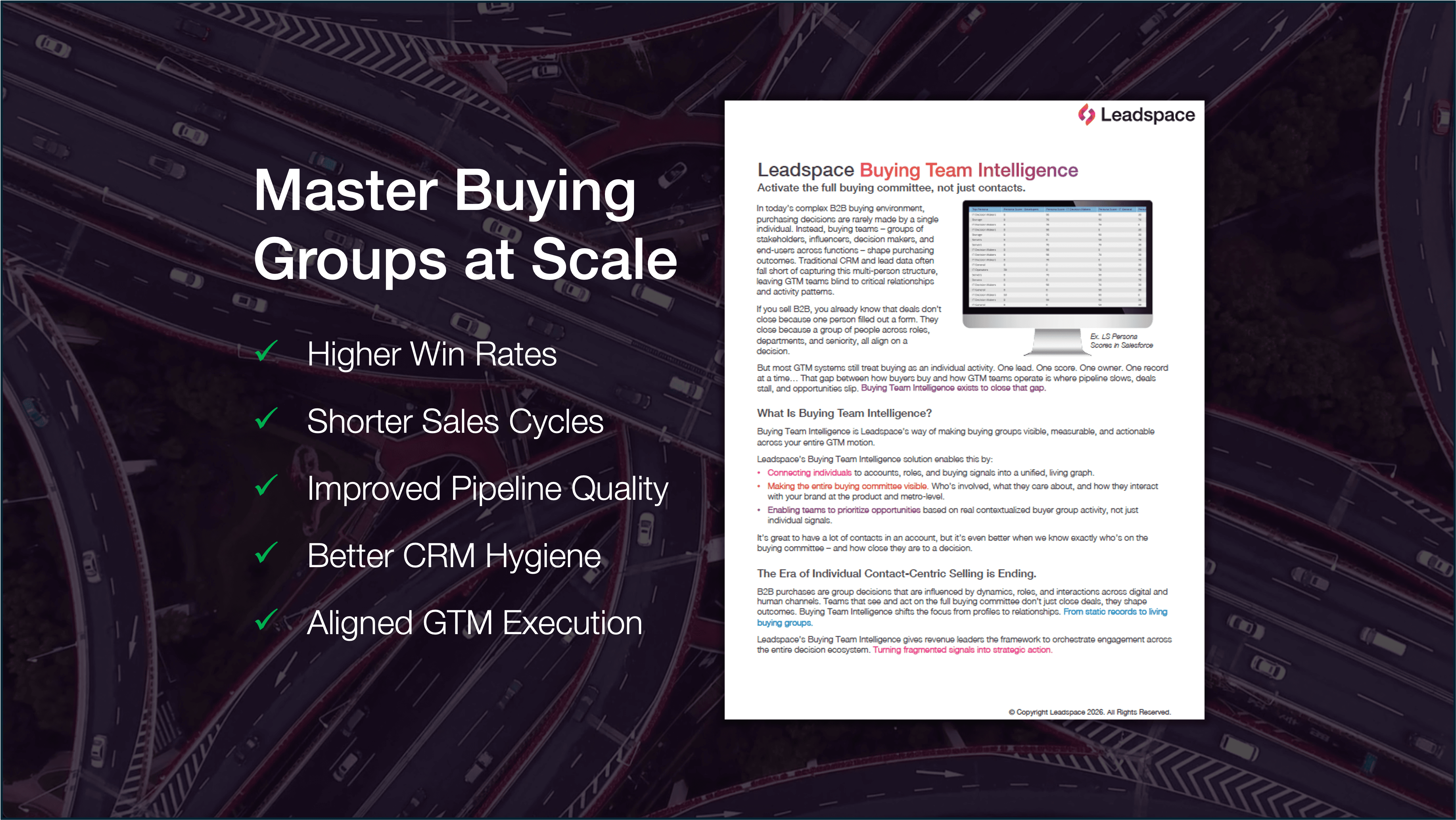
Leadspace Buying Team Intelligence
B2B deals don’t close because one contact engages, they close when an entire buying committee aligns. Yet most GTM systems still operate at the individual record level, leaving revenue teams blind to the relationships, roles, and signals that actually drive decisions.
Leadspace’s Buying Team Intelligence makes buying groups visible, measurable, and actionable by connecting people to roles, accounts, hierarchies, and real-time buying signals in a unified, living data graph.
The result: sales, marketing, and RevOps teams can identify who truly influences and approves decisions, prioritize accounts showing coordinated buying activity, and orchestrate multithreaded engagement based on how buyers actually buy rather than on how CRM records are structured.
Product sheet
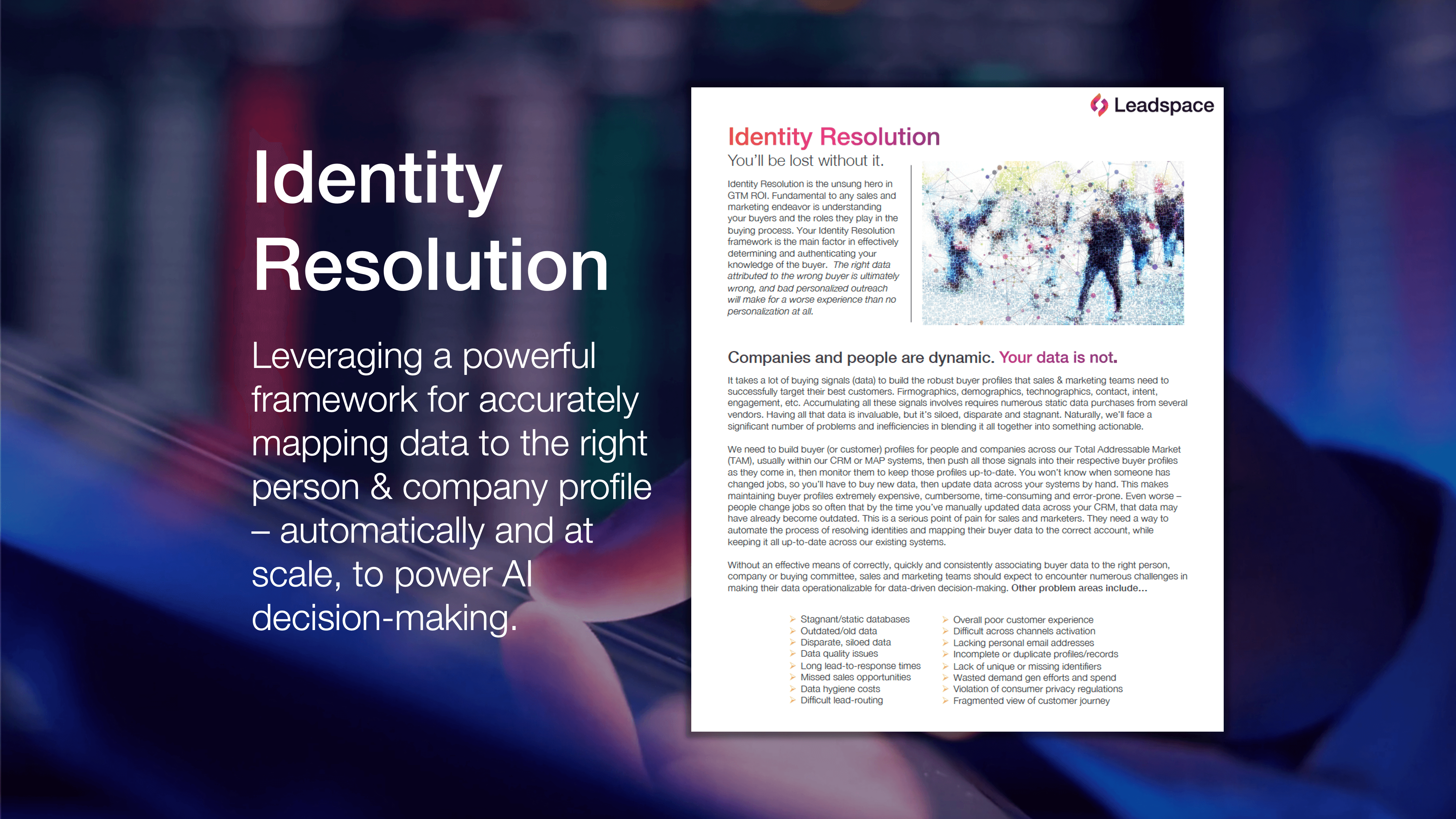
Identity Resolution Guide
Modern B2B growth depends on accurate, unified buyer data. Yet most organizations operate with siloed, outdated, and fragmented signals spread across systems. Identity Resolution is the foundation that ties it all together.
By automatically associating firmographic, demographic, technographic, engagement, and intent data to the correct people, accounts, and buying groups, an Identity Resolution framework creates dynamic, 360-degree buyer profiles that stay accurate in real time.
Instead of manually reconciling records, deduplicating contacts, and guessing at lead-to-account matches, revenue teams gain a trustworthy, continuously updated data layer that powers faster routing, smarter personalization, cleaner CRM hygiene, better forecasting, and true lead-to-account alignment. When identity is resolved correctly, every GTM motion becomes more precise, scalable, and revenue-driven.
Product sheet
Drive Revenue Outcomes with Smarter Inbound Lead Management
If your inbound leads aren’t converting fast enough, you’re not just losing opportunities – you’re funding your competitors’ growth. Today’s buyers expect instant, relevant engagement. That’s why optimizing inbound lead management isn’t just operational hygiene – it’s a revenue growth lever.